The recent increase to the National Minimum Wage (NMW) is a significant development for businesses and workers across the UK. Announced by the UK Government and implemented following recommendations from the Low Pay Commission, the changes will impact pay structures across industrial and commercial sectors alike.
At Simple Recruitment, we support both temporary and permanent placements across warehousing, manufacturing, logistics, office support, finance, customer service and more. From our perspective on the ground, here’s what the wage increase really means.
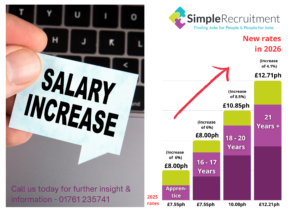
The most recent UK National Minimum Wage and Living Wage increase sees the main adult rate (for workers aged 21 and over) rise by 4.1% from £12.21 to £12.71 per hour, while younger age bands see bigger increases — 8.5% for 18- to 20-year-olds and 6.0% for 16- to 17-year-olds and apprentices coming into effect from 1 April 2026.
A Positive Step for Workers
First and foremost, a higher minimum wage is good news for workers. Many candidates in industrial roles including warehouse operatives, production staff, and drivers are directly affected by changes to the NMW.
The increase:
-
Helps workers manage rising living costs
-
Makes entry-level roles more attractive
-
Supports employee retention in competitive sectors
In commercial environments, such as administration and customer service, the uplift also narrows pay gaps and encourages employers to review salary bands more broadly.
For candidates, it’s a welcome boost.
Increased Pressure on Employers
Industrial businesses, particularly those operating on tight margins in manufacturing and logistics, often feel the impact immediately. Labour is one of the largest operational costs especially for companies relying on temporary staff to manage fluctuating demand.
In commercial sectors, employers may need to:
-
Review internal pay structures to maintain pay differentials
-
Revisit budgets and financial forecasting
-
Explore productivity improvements
For businesses with both temporary and permanent teams, the knock-on effects can influence overtime rates, shift premiums and salary expectations across the board.
The increase doesn’t exist in isolation it shifts the entire pay framework.
What It Means for Temporary Recruitment
Temporary recruitment is often the first area where wage increases are felt.
When minimum pay rises:
-
Agency pay rates must increase accordingly
-
Client charge rates may need adjusting
-
Compliance processes must be reviewed carefully
At Simple Recruitment, compliance is non-negotiable. We work closely with clients to ensure all pay rates meet legal requirements while remaining commercially viable.
The reality is that temporary staffing remains essential for:
-
Seasonal peaks
-
Short-term projects
-
Sickness and holiday cover
-
Business growth periods
The key is planning early and communicating clearly.
Permanent Recruitment Considerations
For permanent placements, the impact is slightly different but just as important.
An increase in entry-level wages can:
-
Raise candidate salary expectations
-
Increase competition for skilled staff
-
Encourage movement in the job market
We’re already seeing candidates reassess their options, particularly in industrial supervisory roles and commercial support positions.
Employers who proactively review their salary packages not just base pay, but benefits, training, and progression opportunities are better positioned to attract and retain strong talent.
The Bigger Picture
The National Minimum Wage increase is part of a broader shift in the UK labour market:
-
Lower unemployment in key sectors
-
Ongoing skills shortages
-
Increased focus on worker wellbeing
-
Greater scrutiny around compliance and fair pay
For businesses, this means recruitment strategy matters more than ever.
How Simple Recruitment Can Help
At Simple Recruitment, we understand both sides of the equation.
We support:
-
Industrial clients needing flexible, compliant temporary staffing
-
Commercial businesses recruiting permanent professionals
-
Candidates looking for stable, fairly paid work
Our approach is simple:
-
Transparent communication
-
Clear rate breakdowns
-
Proactive workforce planning
-
Compliance-first processes
The National Minimum Wage increase doesn’t have to be a challenge with the right recruitment partner, it can be an opportunity to strengthen your workforce.
If you’d like to discuss how the wage changes affect your staffing strategy, get in touch with Simple Recruitment today.