The National Living Wage (NLW) is set to rise for workers aged 21 and over from £10.42 to £11.44 per hour and the National Minimum Wage (NMW) for workers aged between 18 and 20 will increase from £7.49 to £8.60 starting from 1st April 2024. The NMW is the minimum pay per hour almost all workers are entitled to.
The rates which will apply from 1 April 2024 are as follows: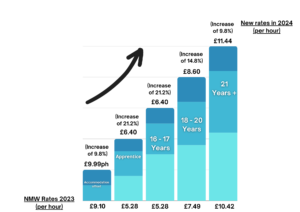
The possible benefits of the National Minimum Wage
Raising the minimum wage has the potential to increase consumer expenditure and enhance the broader economy by providing low-wage workers with additional income.
It also acts as a safeguard against extremely low wages and may help reduce poverty and income inequality within a society. By increasing the minimum wage, the government aims to promote decent working conditions and provide a degree of economic security for workers.
The possible negative effects of the National Minimum Wage
In theory, approximately three million individuals would benefit from this wage boost, particularly in the retail, care, hospitality, and labour-intensive sectors as they employ a significant number of minimum-wage workers. In practice, however, a rise in NMW does have drawbacks and not only to middle and upper management.
The firms within these sectors will see a significant increase in their wage bill which may not affect larger companies as much but will surely have an impact on smaller businesses if they don’t have the funds to pay the increased wages. They may have to cut back on hours, hire fewer workers, or increase the cost of their products and services. This of course may increase the cost of living meaning lower-paid workers are no better off.
A final thought
To conclude, the effect of increasing the NMW is nothing if not complex. It will likely be a double-edged sword as the rise can act as a safety net for lower-paid workers but may also result in more unemployment and an increased cost of living.
There is also the topic of how companies may wish to invest in overseas labour or technology to reduce labour intensive parts of their business, particularly artificial intelligence which is sure to affect the economy in the near future. But that is a topic for another day.
We want to hear from you! How do you think the rise in NMW will affect companies and employees alike?