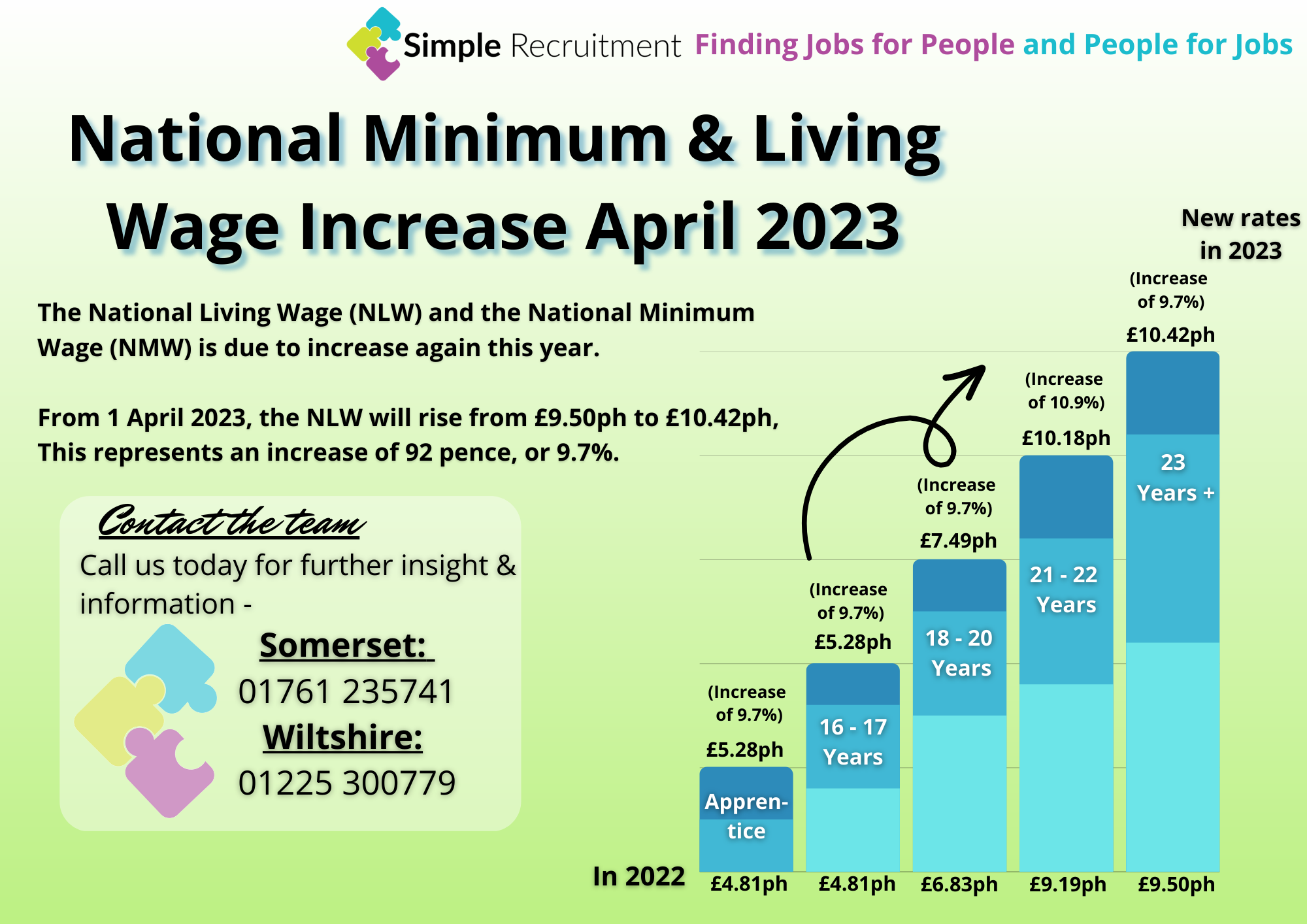
The National minimum wage, as well as the National Living Wage have been announced and are due to rise again this April 2023.
The ‘National Minimum Wage’ is the minimum rate per hour (ph) that employers are obligated by law to pay their employees under the age of 23 years, almost all workers under 23 years are entitled to this. Whereas the ‘National Living Wage’ is the minimum rate (ph) that employers are legally required to pay their employees that are 23 years old and over.
It should be noted that in the year 2024, the plan is for the minimum age for ‘National Living Wage’ to decrease from 23 years, to 21 years.
The ‘National minimum apprenticeship wage’ is also in place for those working under an Apprenticeship Scheme. The ‘minimum apprenticeship wage’ is the minimum rate (ph) that employers are obliged to pay their apprentice’s. If you are aged 16 – 18 years, or 19 years+ and in the FIRST year of your apprenticeship course, you will qualify for this entitlement. However, apprentices will be entitled to the ‘National Minimum Wage’ for their age group if they are/have both the following –
- Aged 19 or over,
- Completed the first year of your apprenticeship.
For April 2023, the increase in rates (ph) is considered the largest increase in ‘NLW’ since its introduction to the UK in 2016, with a view to provide more financial stability across the population and to ease the brunt of the rising cost of living.
Who is not entitled?
Below you can find a list of following types of workers who are NOT entitled to the ‘National Minimum Wage’, or the ‘National Living Wage’:
- Self-employed people running their own business.
- Company directors.
- People who are volunteers or voluntary workers.
- Workers on a government employment programme, such as the Work Programme.
- Members of the armed forces.
- Family members of the employer living in the employer’s home.
- Non-family members living in the employer’s home who share in the work and leisure activities, are treated as one of the family and are not charged for meals or accommodation, for example au pairs.
- Workers younger than school leaving age. (usually 16)
- Higher and further education students on work experience or a work placement up to one year.
- People shadowing others at work.
- Workers on government pre-apprenticeships schemes.
- People on the following European Union (EU) programmes: Leonardo da Vinci, Erasmus+, Comenius.
- People working on a Jobcentre Plus Work trial for up to 6 weeks.
- Share fishermen.
- Prisoners.
- People living and working in a religious community.